• Skip to primary navigation
  • Skip to main content
  • Skip to footer

Teaching in Higher Ed

  • Podcast
  • Blog
  • SPEAKING
  • Media
  • Recommendations
  • About
  • Contact
EPISODE 610

Big and Small Experiments in Teaching and Learning with Mike Cross

with Mike Cross

| February 19, 2026 | XFacebookLinkedInEmail

https://media.blubrry.com/teaching_in_higher_ed_faculty/content.blubrry.com/teaching_in_higher_ed_faculty/TIHE610.mp3

Podcast (tihe_podcast):

Play in new window | Download | Transcript

Subscribe: Apple Podcasts | Spotify | RSS | How do I listen to a podcast?

Mike Cross shares about his experiments (big and small) in teaching and learning on episode 610 of the Teaching in Higher Ed podcast.

Quotes from the episode
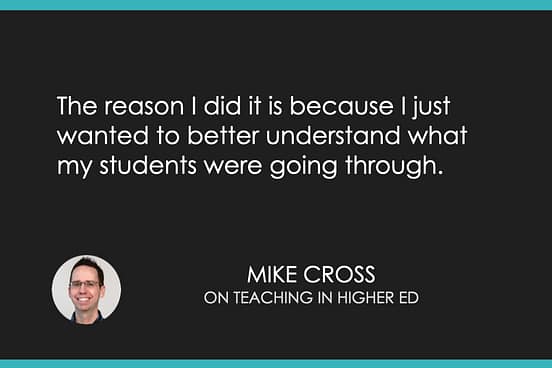
The reason I did it is because I just wanted to better understand what my students were going through.

The reason I did it is because I just wanted to better understand what my students were going through.
-Mike Cross

I love that, that idea of tiny experiments. I think that that is absolutely critical because we're all so busy.
-Mike Cross

Anytime you can put yourself in someone else's shoes, it makes you a better person, right? Whether that's a better teacher, a better spouse, a better friend, a better citizen, anything.
-Mike Cross

Resources

  • Episode 106: Undercover Professor with Mike Cross
  • Snow College
  • Coaching for Leaders Episode 747: How to Get Out of a Rut, with Anne-Laure Le Cunff
  • What Baby George and Handstands Taught Me About Learning, created by Mike Wesch
  • Francesca and the Genie of Science, by Mike Cross
  • Living with Grief: A Poem for Those Who Are Grieving, by Christy Albright
  • The Sweetness at the Bottom of the Pie, by Alan Bradley
  • The Midnight

ARE YOU ENJOYING THE SHOW?

REVIEW THE SHOW
SEND FEEDBACK

ON THIS EPISODE

Mike Cross

Assistant Professor of Chemistry

Even as a child I wanted to be a scientist. In high school I fell in love with chemistry and wanted to pursue a career in pharmaceutical chemistry. As I was finishing my Ph.D. I had the opportunity to teach a summer chemistry course at the College of Eastern Utah and from that moment on I knew that I wanted to be a professor. After teaching in Massachusetts for 11 years I came home to Utah and am happy to be teaching chemistry and forensic science at Snow College. In 2015 I decided to go undercover as a student at Northern Essex Community College in order to better understand the struggles my students are facing. I took the Accuplacer placement exam, enrolled in classes, and spent a year sitting side-by-side with my students before graduating with an Associate's degree in Liberal Arts. It was the best professional development of my career. The lessons I learned transformed the way I teach. In my spare time I enjoy a variety of hobbies, including playing board games, making impossible bottles, practicing my skills as an amateur magician, and creating clockwork insects. I am the author of the children’s book Francesca and the Genie of Science. I am also an active public speaker on a variety of topics, including medical quackery, serendipity in science, and the chemistry of chocolate.

Bonni Stachowiak

Bonni Stachowiak is dean of teaching and learning and professor of business and management at Vanguard University. She hosts Teaching in Higher Ed, a weekly podcast on the art and science of teaching with over five million downloads. Bonni holds a doctorate in Organizational Leadership and speaks widely on teaching, curiosity, digital pedagogy, and leadership. She often joins her husband, Dave, on his Coaching for Leaders podcast.

RECOMMENDATIONS

Living with Grief: A Poem for Those Who Are Grieving, by Christy Albright

Living with Grief: A Poem for Those Who Are Grieving, by Christy Albright

RECOMMENDED BY:Bonni Stachowiak
The Sweetness at the Bottom of the Pie, by Alan Bradley

The Sweetness at the Bottom of the Pie, by Alan Bradley

RECOMMENDED BY:Mike Cross
The Midnight

The Midnight

RECOMMENDED BY:Mike Cross
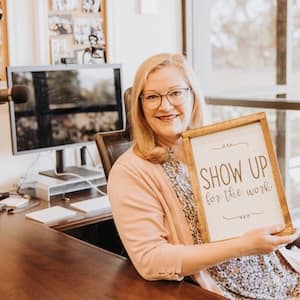
Woman sits at a desk, holding a sign that reads: "Show up for the work."

GET CONNECTED

JOIN OVER 4,000 EDUCATORS

Subscribe to the weekly email update and receive the most recent episode's show notes, as well as some other bonus resources.

Please enter your name.
Please enter a valid email address.
JOIN
Something went wrong. Please check your entries and try again.

Related Episodes

  • EPISODE 335Trauma-Informed Teaching and Learning
    Mays Imad Square

    with Mays Imad

  • EPISODE 456Mobile-Mindful Teaching and Learning

    with Christina Moore

  • EPISODE 412Teaching and Learning with Refugees
    Céline Cantat headshot

    with , Céline Cantat, Ian M. Cook, Prem Kumar Rajaram

  • EPISODE 206Inquiry-based Learning
    Jeffery Galle

    with Jeffery Galle


EPISODE 610

Big and Small Experiments in Teaching and Learning with Mike Cross

DOWNLOAD TRANSCRIPT

EPISODE 610: Big and Small Experiments in Teaching and Learning with Mike Cross 

Bonni Stachowiak [00:00:01]:

Today, on episode number 610 of the Teaching in Higher Ed podcast, big and small experiments in teaching and learning, with Mike Cross.

Bonni Stachowiak [00:00:13]:

Production Credit: Produced by Innovate Learning, Maximizing Human Potential.

Bonni Stachowiak [00:00:22]:

Welcome to this episode of Teaching in Higher Ed. I’m Bonnie Stachowiak, and this is the space where we explore the art and science of being more effective at facilitating learning. We also share ways to improve our productivity approaches so we can have more peace in our lives, and be even more present for our students. Today on Episode 610, I’m joined, I should say rejoined, by Mike Cross. He’s a chemistry and forensic science professor at Snow College, and he underwent what I would most classify as big, in fact, big seems too small of a word in this case, I don’t want to spoil it for you because I want him to tell you the story, but he’s been doing some big and small experiments having to do with his teaching and learning, and I’m so excited for you to hear the conversation. However, I want to read the last paragraph of his bio because some of the things didn’t come out in our conversation.

Bonni Stachowiak [00:01:27]:

I don’t want you to miss them. He’s such a great, fascinating, fun person. So he writes, in my spare time, I enjoy a variety of hobbies, including playing board games, which did come up when he was on the podcast a long time ago but doesn’t come up in today’s conversation, making impossible bottles, practicing my skills as an amateur magician, and creating clockwork insects, which of course I’m going to have to go and look and see what those are. And he says he’s also an active public speaker on a variety of topics, including medical quackery, serendipity in science, and the chemistry of chocolate. All right, join me in welcoming to the show Mike Cross. Mike Cross, welcome back to Teaching in Higher Ed.

Mike Cross [00:02:13]:

Thanks, Bonnie. It’s great to be here again.

Bonni Stachowiak [00:02:16]:

Yeah, again. I want listeners— It’s been a while. I want listeners to know that when he says that, I looked it up; Episode 106, and we are now recording episode 610. So to say it’s been a minute, it’s been a minute. And the reason I decided to reach out to you, is that I started talking on another episode that I recorded recently, and Mike, people think that I have a very good memory when I do things like this. And I’m like, I have actually a terrible memory.

Bonni Stachowiak [00:02:48]:

If you don’t believe me, talk to Dave, my husband. He will tell you, big picture thinker, not, you know, always remember the details. Yes, but I— but the, the way my brain just flashed with such vivid detail. I’m so glad and grateful to be talking to you again because everything started flashing, and I started to doubt myself too, because I’m like, bacon, bacon, game board, board games, bacon, board games, like escape room. Like, it was a kind of vividness that, again, I don’t tend to experience. But for those who didn’t listen back then, or even those who might have a need of refresher, would take us back to this marvelous, unconventional experiment that you undertook way back then?

Mike Cross [00:03:34]:

Sure. So I had to look at my notes to find out the dates, which is pretty surprising, but it would have been, summer of 2015. So I was— I’m— well, let me back up a little bit. I’m a chemistry professor, and I was teaching at Northern Essex Community College. I had just gotten tenure. I was kind of, you know, set in my career. It’s like, this is perfect. And that summer, I guess it was spring, end of spring,

Mike Cross [00:03:59]:

I had decided to go undercover as a student at the community college where I was teaching. So I got my transcript. I went into the advising center, and I sat down, and I took the ACCUPLACER. I did everything, undercover, spent a whole year just doing everything right, taking all the courses that I needed to, and eventually graduated with my associate’s in liberal arts. Which is a little different than my normal chemistry degrees.

Bonni Stachowiak [00:04:30]:

And Associate in Liberal Arts, how long did that take?

Mike Cross [00:04:33]:

It took me a full year, but that’s with summer, spring, fall, winter session, everything.

Bonni Stachowiak [00:04:39]:

And tell us a little bit about, like, you went undercover, but you also had a set of ethics and morals that you weren’t going to go undercover. Like, sometimes the late-night talk show hosts will do these little, where I’m like, that’s not fair to the kids, don’t tease them that way. That’s not fair. So I felt like you had a good way of, yes, going undercover, but you did have some boundaries around that. How did you decide when to reveal to people?

Mike Cross [00:05:05]:

Right. Yeah. So I— the reason I did it, is because I just wanted to better understand what my students were going through. You know, what were they facing? I was a traditional student straight out of high school going into college, and most of my students weren’t. And so I wanted to go in, and just see things from their perspective. So, before classes began, I’d always talk to the professor and just make sure that they were comfortable with it. I didn’t want them to think that I was testing their teaching or, or trying to like squeal to the administration or anything like that. I didn’t want students to feel like I was trying to, to sneak around and police them or anything like that.

Mike Cross [00:05:41]:

So basically, most of the time, only the professor knew. And then if people asked like, hey, you know, what do you do for work? I’m like, oh, I’m a chemistry professor here. I’d let people know. I wasn’t— I would never lie about it, but I wouldn’t volunteer it either. And so in some classes, I— my public speaking class, I walk in, I knew multiple students who were my students. And so they’re like, Professor Cross, what are you doing here? And so obviously, the cat was out of the bag. But in most cases, I tried to keep it on the down low, just because I didn’t want things to be awkward for the other students.

Bonni Stachowiak [00:06:13]:

I’m, I’m curious about like, how did this all happen? How does one get quote-unquote permission? How do you design a, a grand experiment like this? I mean, it— there’s both the how did you do it, but there’s the how did it, you know, happen in the first place?

Mike Cross [00:06:29]:

Yeah, maybe I should have planned it better, but literally, there was no planning. I was sitting at a graduation ceremony or an award ceremony, clapping for students, thinking of all the great things they had overcome, but also thinking of all the students that weren’t there. Students that it’s like, oh, Marissa, she was great, but she’s not here. What happened? She dropped out halfway through the semester. And thinking, man, they face a lot of challenges. Most of my students had families. They were working at least one job. They were caring for elderly parents or disabled siblings, or like, they had so much going on.

Mike Cross [00:07:01]:

And so that night, as I’m sitting there clapping, I thought, you know what, I want to do this. I just want to go and see what they’re experiencing. And so I literally went in the next day, and just showed up, and there it was. So there was literally no planning.

Bonni Stachowiak [00:07:16]:

Oh, were you— so you were teaching at the same time?

Mike Cross [00:07:19]:

Yes.

Bonni Stachowiak [00:07:20]:

Oh yeah. So I don’t know if you told me all those years ago, back in 2016 and I have since forgotten that detail, or if perhaps I missed asking you that very important question back then. So this is even more extraordinary than I even remembered. Now I’m like, holy cow, how on earth? How on earth?

Mike Cross [00:07:42]:

Yeah, so I was teaching, 3 kids, wife, full-time job, everything, right? Which really did simulate a little better what my students experienced.

Bonni Stachowiak [00:07:51]:

Oh yeah, yeah. And what for you, for listeners’ sake, what for you was a full load of teaching? How many units?

Mike Cross [00:07:59]:

Let’s see, so generally I would teach probably about 3 classes which have labs, and then I’d usually teach as an adjunct, maybe another 2 or 3 classes. So we’re talking, you know, most of my 9-to-5 days and sometimes evenings were booked just with teaching. Every now and then, I’d have an hour in the middle of the day, you know, and I would say, okay, that’s when I’m going to take my class. Or, you know what, I’m going to take one face-to-face, one hybrid, one online, because I wanted all the modalities. I wanted a little bit of everything.

Bonni Stachowiak [00:08:34]:

And how old were your kids then, now?

Mike Cross [00:08:37]:

And let me do some math here. 10 years ago, my 3 kids would have been 11, 8, and 5. And so yeah, now, the oldest 2 are in college. My, my son, he’s in high school. And then, my wife and I have a 2-month-old now. So it’s a little different, yeah. Going back, and testing it out again.

Mike Cross [00:09:00]:

Trying parenthood again. It’s fun.

Bonni Stachowiak [00:09:02]:

And so not only has this experiment now ended many years ago, but you’ve had some other transitions. So, do you want to catch us up a little bit? What does your life look like now besides the 2-month-old, which I could only assume means some slices of sleep deprivation? But tell us, fill in the gaps.

Mike Cross [00:09:18]:

Just a bit of sleep deprivation. But I will say, you know, not to brag, but he is the most adorable 2-month-old on the entire planet from my very objective observations. So, um, he’s great. Let’s see. So, I was, 10 years ago, I was teaching at Northern Essex in Massachusetts about, it was middle of COVID, so June of 2020, I moved to Utah. So I’m teaching at Snow College, which is an amazing little junior college in the middle of Utah, up in a little mountain valley, pretty amazing place. I absolutely love it here. Yeah.

Mike Cross [00:09:54]:

Family changes. Um, what else? Yeah, it was, it was a big change. The career change was huge, still teaching, but Snow College is, according to the Chronicle of Higher Ed, the number one successful college in the nation. We have a 73% success rate. It’s also the cheapest in Utah, talking $4,000 a year for tuition. It’s, it’s a great place, and I definitely wanted to be part of that. Also, with COVID hitting, I wanted to be closer to family. There’s a lot of reasons for the move, and Northern Essex, still an amazing place, still a lot of friends out there that I’m so grateful that I spent 11 years there.

Mike Cross [00:10:28]:

But, it’s a big change starting over, going from being a full professor, tenured department chair, to starting over, you know, and going through the tenure process again and all of that. But I’m grateful for— I’m glad that I’m here. Very glad.

Bonni Stachowiak [00:10:44]:

There’s a book that is right there on my queue to get to, but there’s also books that I read for the podcast prep, so it hasn’t jumped up as much as I want it to. It is tugging at my attention. Also happens to be an interview that my husband did on his Coaching for Leaders podcast, and the book is called Tiny Experiments. And I will clumsily try to tell you the premise, even though I— sorry, I may get some stuff wrong here, but the idea instead of setting goals, you know, the longer-term stuff, that it’s those tiny experiments that, that actually can really be some fulcrum dynamics for us to really achieve more. You know, anyway, that’s my clumsy, clumsy thing. So I was kind of wanting to ask you about, like, I, I kind of have this sense about you. By the way, listeners should know Mike and I have not planned this conversation at all. I reached out, and it feels like 2 seconds later, here we are.

Bonni Stachowiak [00:11:34]:

So fun to have you back on the show. There’s no way in which you’re not still experimenting in your teaching. So would love to hear, both anything grand that you’re doing, but I almost feel like it’s the small stuff that, that can raise more hope that others might feel like they could maybe try to experiment with some of the small ways that you’re still trying to study your own teaching, your own learning as a human being. So anything to share, either big or small, or everything in between.

Mike Cross [00:12:00]:

Sure. Yeah. So I love that, that idea of tiny experiments. I think that that is absolutely critical, because we’re all so busy. No one, you know, very few people have time to go undercover and take a full load of courses on top of full work, and family and everything else. But as I was sharing my experiences with people, I got a full range of feedback from different college- colleges as I was speaking there, and conferences, which I can get to later. But the main takeaway that, that I have is that anytime you can put yourself in someone else’s shoes, it makes you a better person, right? Whether that’s a better teacher, a better spouse, a better friend, a better citizen, anything. And so that’s what I’ve really tried to focus on.

Mike Cross [00:12:50]:

I have never tried to go fully undercover again to re-experience everything, but I have tried to I guess the main thing is listen to my students. You know, as a professor, I have students coming into my office for help all the time. And so, sitting down with them and having honest conversations about where they’re at, and what’s going on, and how can I help. Sometimes I think as professors, we tend to see ourselves as like disciplinarians, you know, police, where it’s like, I need to catch students cheating, I need to do this, I need to like catch them and find out what they don’t know so that I can give them the lowest grade possible. And not everyone’s like that, of course, but I think that as we sit down and try to say, you know what, my goal is just to help you achieve your potential, achieve these learning outcomes. So how can I get you there, right? How can I be compassionate enough that if you attend a funeral, I’m not going to fail you because you missed, you know, an assignment. I can give you an extra day to do that, right? It costs me nothing, and it means a lot to students.

Bonni Stachowiak [00:13:54]:

There’s a wonderful video from Mike Wesch that I treasure, and he’s given me permission to share it, in speaking that I do as well. And it’s what Baby George and Handstands have taught me about learning. And it is kind of an example of these, to some people, tiny experiments. I mean, in terms of very much in the spirit of what you just said, Baby George, by the way, just by the way I’m phrasing that, would be a baby at the time. And he has a, in the video, which I will link to in the show notes, ’cause people really need to go see it, versus my description of it. But you’ve seen this as a parent, Mike, coming down the stairs, and we’re tripping, we’re falling, we can’t do it. And he just had a whole looping of like, what does that growth look like as the confidence builds, and as these motor skills come together, and the interplay between, you can see it on Baby George’s face, you know, the interplay of these two things. And then for the handstands, he teaches anthropology, and so he’s emulating for his students his own willingness to learn new things.

Bonni Stachowiak [00:14:56]:

I’ve never been so saddened that there was only one episode of a podcast. He did an audio podcast called Life 101 way, way, way, way back when, and he, like, he literally undertook an experiment asking students to teach him things. It’s the most gorgeous work of audio, and then it just, the project didn’t continue after that. And I mean, one of the students teaches him how to dance, and he’s, he’s, I think I remember that we’re the same age. And so that was also interesting because some of the music that he selected, I was like, so it was resonating with me, and that feeling of like, “I used to be able to do this thing, but man, this is like super awkward!” It was just a delightful piece. But the reason I bring it up is that you talked about listening to your students, trusting them. You talked about how important it is to put yourself in someone else’s shoes.

Bonni Stachowiak [00:15:50]:

Are there things that are coming to your mind of small ways, that whether you are trying to learn how to do handstands— I should mention he learns how to do it in front of his students. And so they get to watch these little glimpses of him, of him doing it. So, um, anything come into your mind of like things that you’re doing in your life, tiny things potentially, that put you in the shoes of a learner? Like doing something new. That’s his whole thing, is like whether baby George is doing something new, or he’s doing something new with the handstands, or, you know, back in the day of his Life 101 podcast, learning how to dance from his students. Are there ways that you are disciplining yourself to like do those little things, put yourself in a, in a beginner’s mind state?

Mike Cross [00:16:34]:

Sure. Yeah. So I don’t know if I ever mentioned this last time I was on, but I’m an amateur magician, right? So the very first semester I started teaching, I was so panicked that students would ask me questions I didn’t know the answer to, that I decided to learn magic tricks so that I could say, “oh, here, let me illustrate that”. Do a magic trick, distract them, go home and Google it, come back the next day and say, “oh, did I finish answering your question?” And I was— that literally was the reason I got into magic. And so, but my students love it. And so even now, that I don’t mind not knowing answers to questions, I still do magic tricks every day in class, a different magic trick every day. But I decided, you know what, I want to try not just doing someone else’s, but doing my own. It’s a— it’s hard to figure it out, right, to, to come up with that. So I ended up publishing a couple of magic tricks with Penguin Magic.

Mike Cross [00:17:25]:

A while back, I wrote a children’s book, just for fun. That’s called Francesca and the Genie of Science. You can find it on Amazon, if you want to learn about a little girl finding a genie in her broken-down microwave. And people have described it as, like if Dr. Seuss stories were written by Bill Nye, the Science Guy, right? All the science is accurate, but just a little different. But because of that, because I learned so much in the process of doing that, and had so much fun with it, that that’s now a project that I have my students do. Where I say, you know what, instead of having you write yet another research paper about Marie Curie, why don’t we write a children’s book? And so I have them each choose a different topic, you know, in the semester, and then we go through the whole scaffolded process of writing that, and getting it illustrated. I had one of my former students illustrate my book, which was fabulous. My students can, you know, I’m not an art professor, so I don’t mind if they use AI for the illustrations, or do stick figures or anything else.

Mike Cross [00:18:23]:

But I tell them, I’m testing you on the science, and whether you know the science well enough that you can explain it to a 5-year-old. And if you can, then you really know what you’re talking about. And so, little things like that, where my students, I think, enjoy it a little bit more because it’s something different, and because it lets them kind of explore the fun part of science, rather than just memorizing the periodic table. I’ve also really have been working on trying to make my classes a little more applicable. So for instance, most college students need a science credit, right? And so they usually take physics, or astronomy, or geology, or chemistry, and there’s nothing wrong with that. But both at Northern Essex and here at Snow, the class that my students requested the most was forensic science. So developed a new forensic science course at both colleges, and it is crazy popular, and it allows them to learn all of those critical thinking skills that they need to get their degree, but in a way that they actually enjoy, that they’re excited about, that they— I’ve never had so much participation in class as in that class. And I’m not a forensic scientist by trade.

Mike Cross [00:19:34]:

I’ve had to learn it. And so I tell my students like, “hey, you bring in cases, you bring in things that you want to talk about, and we’ll do it”. And they love it. They absolutely love it.

Bonni Stachowiak [00:19:43]:

I only know enough to be dangerous, maybe, maybe not even dangerous. I probably don’t know enough to even be dangerous when it comes to forensic science. I mean, I know what that means. I know what those words mean, and I am familiar, somewhat with the discipline, but not enough to know— are you able— it sounds like you can make them be very curious. So I’m like, I want to take your class right now. Can I go undercover? Who, who will pay me to go?

Mike Cross [00:20:06]:

To take this class from you?

Bonni Stachowiak [00:20:08]:

I will take all of your classes from you. So, I can anticipate the amount of curiosity you’re able to generate. Are you also able to have it be something where they see it play out in their own relevance in their life? I’ll give you a quick example. My son taking, I think it was, I don’t even know, it was a STEM class. I’m not even gonna get specific, but, oh no, he might’ve just said math. Anyway, we were going, we go most nights, our family will go around for a walk after dinner. This particular case, it was just he and I, but usually it’s the 4 of us.

Bonni Stachowiak [00:20:46]:

But on this walk, I just remember he was— he gets so into his 3D printing, and it was just this flash, where I just wanted to stop everything. I felt like everything stopped, where he’s like, “Mom, Mom, Mom, see, I can finally use math now!” Or maybe it was geometry. But anyway, but anyway, it’s just like, like that he had been learning these things that up until that point had been theoretical, and it was just like that, so fun to get to see the light bulb go on. Do people that take forensic science get to see that light bulb go on in a practical way in their lives? Of things, problems they’re trying to solve, or things they’re trying to create, or something like that?

Mike Cross [00:21:23]:

Yeah, I mean, with forensics, chemistry, it’s a little easier because there’s always examples of like, don’t eat this, don’t lick that, right? Because that’s going to kill you. So that’s, that’s easy. But forensic science, hopefully most of the time, they’re not dealing with dead bodies and things like that. But they do definitely are able to see kind of the good and bad of how things are portrayed on their favorite TV shows, because everyone loves some kind of CSI-type show. And so, they love being able to either nitpick and say, nope, that’s not how you do it, you’d get— you’d be thrown in jail if you did that, right? That’s not what CSIs do. Or to be able to say like, “oh, that actually is exactly what I was taught, that’s how it works”. I think the main thing that they are able to apply from it is, how do you step back and not make assumptions and follow the evidence, right? Follow— like, here, I can piece together what occurred based on these things, not my suppositions of what I think happened, but using evidence. And I think that no matter what their major is, because 99% of these students are not science majors, right? They’re taking it because they need a science class to graduate.

Mike Cross [00:22:31]:

But if they someday can step back and say, you know what, instead of making an assumption about this person or about this news article, I’m going to look at the evidence, then I’ve done my job. And that’s, to me, what science is all about— critical thinking.

Bonni Stachowiak [00:22:45]:

I have a movie reference that not everyone will get. There was a movie way back when called The Sixth Sense, and one of the classic quotes that people would hear from that movie, or see in, in, uh, you know, fragments of, whatever’s left over from across social media, is, “I see dead people.” And I will tell you that my parents used to do search and rescue with their dogs, so they did canine search and rescue, and they would use their noses in different ways. So, if it was an area search, their noses would be up, and they’re looking for any person that’s in this field, or forest, or whatever. And then if it’s, if the dog’s noses go down, then they’re looking for a specific, so, you’d give them a scent article and then send them out to look. And so, I was always convinced there should be a movie where it’s, “I smell dead people,” because they actually used to go, I mean, it sounds really morbid, and it’s kind of jolting to people, but since you brought dead people up, I got to join you in it. They would bring comfort to some families because sometimes the dogs would go and help find a dead person, a cadaver. But to train them, they needed to have synthetic cadaver scent.

Bonni Stachowiak [00:23:57]:

And so speaking of an episode from a long time ago, when Mike Caulfield was on for the first time, I told this story about how some Easters as an adult, I would be alone, because my parents would go and on Easter, take the dogs on a cadaver Easter egg hunt.

Mike Cross [00:24:18]:

That is pretty crazy.

Bonni Stachowiak [00:24:19]:

It’s like such a classic thing where you don’t realize how weird your family is until you talk about it. It’s like, what on earth? It’s so funny. So funny.

Mike Cross [00:24:28]:

No, that, yeah, that takes me back. So when, when my, my youngest daughter was probably about, I don’t know, 6 or 7. My family’s weird too, but I was— we were dissecting frogs on the kitchen table, as you do.

Bonni Stachowiak [00:24:43]:

As people do.

Mike Cross [00:24:45]:

Yeah, of course. So afterwards, after the dissection, we’d taken out the organs, we’re weighing them, you know, and she’s learning all about it. She thinks it’s great. And afterwards she said, you know, my sweet little daughter says we should give this frog a proper burial, right? And I said, oh, that’s really sweet. We could do that, or we could put it in the backyard by the anthill, and we could watch as the flesh gets torn off the bones. And she said, “let’s do that”. So that’s what we did. It’s funny because it was part of a lab that I was going to be using for my students, and so I always run through a lab myself.

Mike Cross [00:25:22]:

I guess going back to tiny experiments, literally, if I’m going to be doing it with my students, I’m going to do it with me, and my kids, and we’re going to run through it, find anything that goes wrong before we actually get there. But she absolutely loves it. She wants to be a nuclear physicist now. So, good times.

Bonni Stachowiak [00:25:40]:

I love that. I really enjoy doing assignments alongside with students too, and I’m not even sure that they quite get it in the sense of like, I— because I think it’s— they’re just not used to that, you know, that professors would do that. So I mean, what a wonderful thing that you’re— I mean, I just imagine that brings them so much delight. Well, before we get to the recommendations segment, is there anything else that you want to share as far as, as you contrast back to this magnificent elaborate experiment, and then you’ve shared some of these smaller, although they just seem like ongoing as a way of being, as a human being, anything that you want to share as far as advice for someone who wants to take that first step, who maybe realizes, perhaps I’m not putting myself in enough circumstances where I can put myself in other shoes? How do I start small so I don’t get overwhelmed, and then never actually take that first step?

Mike Cross [00:26:40]:

Yeah, so for me, I would say definitely start small. I, even though I don’t go undercover anymore, I still sit in every semester on at least one other professor’s class. Not every class, right, but I go to a class, and it can be anything. Most faculty are more than happy to have you come and just sit down. They, they like to teach, and so, sitting in and finding out something new that I don’t know, about a psychology class or about anything, like, it does a couple of things for me. It helps me to see better teaching methods that I hadn’t thought of, but it also helps me to get excited about learning again. And I think that’s one of the benefits of trying to be a learner, and doing these tiny experiments, is realizing just how fun it is, how exciting it is to learn. I try to refresh my, my teaching whenever possible.

Mike Cross [00:27:32]:

I try to come up with fun assignments. So come up with just something new, something weird. For, for my forensic science final exam in lab, they show up, and it’s a Lord of the Rings Middle-earth scenario where Bilbo Baggins has been murdered, I mean, murdered, right? And so he, they have to solve the crime, and it’s fun for them, and it’s fun for me to come up with those scenarios, to come up with just something different, something that students don’t expect. Because that way they can enjoy it. They can— it kind of takes some of the pressure off of being a learner, right? Of being new to something, and worried about failing. Because if you’re having fun while you’re doing it, then it’s okay, right? You don’t mind looking dumb if you’re having a good time, and so is everybody else. And especially if it’s low stakes and life’s good, then yeah. So that’s, I guess, my biggest thing.

Mike Cross [00:28:23]:

And then always just look at everything from a student perspective, whether it’s a new college policy, whether it’s a new teaching method, whether it’s me deciding whether or not to have them purchase a new textbook, I look at it from their perspective, and is it going to benefit them? If not, why am I doing it?

Bonni Stachowiak [00:28:41]:

Thank you so much. What a delight to get to have you back on the show, and also a delight for us to get to share our recommendations. And I feel like I’ve been making some sound effects on this podcast, so now I feel like I have to do the sound effect of like, brakes screeching or something like that, because I’m about to make a huge mood turn here. Spoiler alert, back on episode 597, I was able to have back to the show Clarissa Sorensen Unruh, she goes by Rissa, and her sister Christy Albright, and they talked about teaching, learning, and the lessons of grief. And if you missed that one, in fact, I may have just misspoke. I’m realizing I had a typo there: 596. I will have a link, of course, on the recommendation.

Bonni Stachowiak [00:29:29]:

So that you can go and listen. I mean, it’s just a beautiful, cannot miss, cannot miss episode, because the fact is, all of us are going to experience seasons of grief. It is part of the human condition, and it was just such a gorgeous, gorgeous episode that I will treasure, treasure for as long as I’m probably alive. So, as someone experiencing some grief of my own, I wanted to read this poem that Christie Albright has shared on her website. She wrote it in January 2026. Again, these are Christie Albright’s words. I’ll put a link in the show note to Living with Grief: A Poem for Those Who Are Grieving. Quote: I don’t have anything to say, floated round the river in my head, as friends and family experienced crippling deaths of loved ones, work trauma, family trauma, national trauma, and nature’s wrath.

Bonni Stachowiak [00:30:31]:

Quote, I know grief. I know I’m grieving too. How can I help? But my heart remained mute, silent, wordless. Then quietly, gently, softly, from a place deep in my soul, the place my ancestors speak, these words came for me, and anyone who will listen. You can do this. Give it time. It’s okay to feel anger. It’s okay to feel deep, seemingly uncontrollable sorrow.

Bonni Stachowiak [00:31:12]:

It’s okay to laugh and feel joy. It’s okay to feel like you’re in a daze, and it’s okay to feel clarity and focus. It’s okay. Just keep living life one step at a time. Eventually, maybe in a few weeks, maybe in a few years, you’ll realize you have found a new way of being, of loving, of living, and that your grief is not gone. It’s become a precious and valuable part of who you are ,and how you live in the world. In the meantime, surround yourself with people who care about you, grace for mistakes and forgetfulness, food that nourishes you, and activities that bring peace in the midst of the internal storm, and supply energy to your inner core. Ask for help to do basic things, to do hard things, in seeking companionship.

Bonni Stachowiak [00:32:19]:

And when you get stuck in a grief loop, remember: you are loved. You are a precious part of the world. Your voice and your experiences matter. You make the world better just by being you, just as you are right now, messy and imperfect’. Thank you, Christie Albright, for those words. As you can clearly tell, I am so moved by them today. It feels like, so serendipitous that I’d be having this conversation with Mike that helps me think about time over such a longitudinal thing. And Mike is reminding me today of my purpose, who I am, who I was created to be, and who I am becoming.

Bonni Stachowiak [00:33:07]:

And I’m treasuring this beautiful conversation. I’m treasuring that we could laugh together today. And I’m treasuring that we could— I could read these words from Christie, and be reminded of these things. And to anyone listening who needed to be reminded of those things as well. I know you’re thanking Christy Albright as well. So I will pass it over to you, Mike, for whatever you would like to recommend.

Mike Cross [00:33:29]:

Thank you. That was, that was really nice. Um, it’s too bad that we have so much grief, but at the same time, it really does make us who we are. And so as we’ve been talking about having compassion for students, I think having compassion for ourselves, being okay not being okay all time, I think, is, is just fine. Not always being on top of our game is just fine. Let’s see, so I have two quick recommendations if that’s okay. First one, fabulous book, it’s been out for a while. I think there are 11 books in the series now.

Mike Cross [00:34:02]:

Alan Bradley’s The Sweetness at the Bottom of the Pie. If you’ve never read that, absolutely phenomenal. A nice cozy kind of Victorian mystery about an 11-year-old named Flavia DeLuce, who is an amateur chemist and, uh, likes to find dead bodies and solve crimes. So it really is everything that I love. Lots of comedy in it. Just really, really great book. So it’s my first recommendation. The second is, I don’t know about you, but if you’re listening to music and you think to yourself, man, I just wish that there was like modern music that sounded like it was written in the ’80s.

Mike Cross [00:34:36]:

I mean, that’s all I think about, right? And so, luckily for all of us, there’s a music movement called synthwave that’s all about making music that sounds like it was written in the ’80s. And my favorite band right now is called The Midnight, and it’s all about just sounding like that. And there’s something, I guess maybe because of that time, or, you know, looking back on the past, something really soothing about turning on some music, and just driving, and then just kind of being transported back into time. I really enjoy it. So those are my recommendations.

Bonni Stachowiak [00:35:09]:

Thank you so much. What a delight to get reconnected with you. And not to sound weird, but it’s almost like we have been walking alongside. I mean, I, I feel like I, I’ve thought back so many times to that conversation. I know I’m going to be thinking back to, to today’s conversation too. What a delight to have you back on the show.

Mike Cross [00:35:26]:

Well, it’s been a pleasure. Thank you so much. I was so excited to, uh, to hear from you.

Bonni Stachowiak [00:35:32]:

Thanks once again to Mike Cross for joining me on today’s episode of Teaching in Higher Ed. Today’s episode was produced by me, Bonnie Stachowiak. It was edited by the ever-talented Andrew Kroeger. And if you’ve been listening for a while and you haven’t signed up for the weekly emails, you’re going to get all these good show notes, but you’re also going to get some quotable things that don’t show up, and some recommendations and other good stuff. So head over to the teachinginhighered.com/subscribe link. And it’s time, it’s your moment, sign up for the email. And thank you so much for listening and being a part of Teaching in Higher Ed. And I’ll see you next time.

Expand Transcript Text

TOOLS

  • Blog
  • Podcast
  • Community
  • Weekly Update

RESOURCES

  • Recommendations
  • EdTech Essentials Guide
  • The Productive Online Professor
  • How to Listen to Podcasts

Subscribe to Podcast

Apple PodcastsSpotifyAndroidby EmailRSSMore Subscribe Options

ABOUT

  • Bonni Stachowiak
  • Speaking + Workshops
  • Podcast FAQs
  • Media Kit
  • Lilly Conferences Partnership

CONTACT

  • Get in Touch
  • Support the Podcast
  • Sponsorship
  • Privacy Policy

CONNECT

  • LinkedIn
  • Instagram
  • RSS

CC BY-NC-SA 4.0 Teaching in Higher Ed | Designed by Anchored Design